In This Article
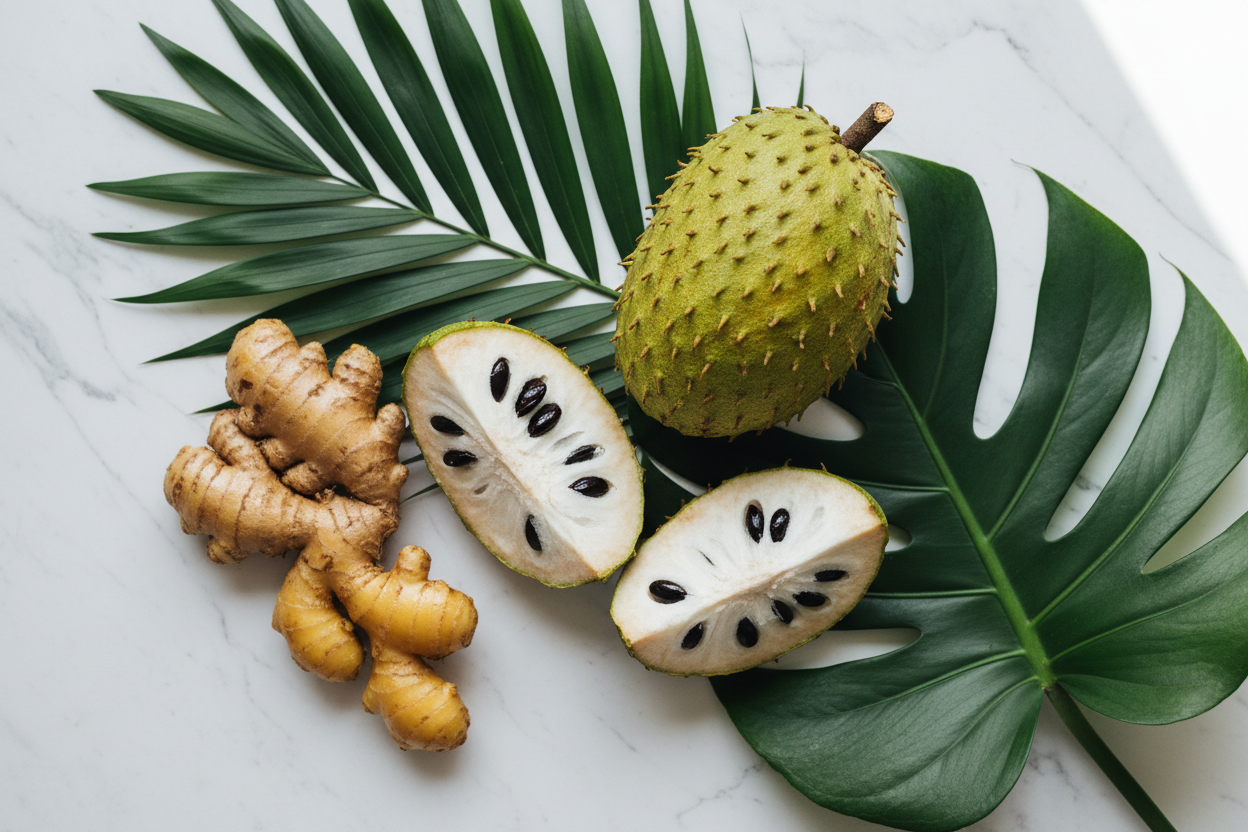
If you've never heard of soursop, you're in the majority — at least in the Western world. In the Caribbean, Central America, and parts of West Africa, Annona Muricata has been used medicinally for centuries: for fever, for inflammation, for skin conditions that Western dermatology once struggled to treat without steroids. The fruit is spiky, green, and roughly heart-shaped. Its flesh is white and custard-like, with a flavor somewhere between pineapple and strawberry.
None of that is why skincare scientists are paying attention. They're paying attention because soursop contains a class of compounds called acetogenins — and acetogenins don't behave like anything else in nature.
What Is Soursop, Exactly?
Annona Muricata is a tropical flowering tree native to the Caribbean and northern South America, now cultivated across subtropical regions worldwide. Every part of it — leaf, bark, root, fruit, and seed — has demonstrated biological activity in research settings. The leaves, in particular, are extraordinarily dense in polyphenols, flavonoids, and the acetogenin compounds that have made the plant a subject of serious scientific interest.
In the context of skincare, the most relevant preparations come from the fruit pulp and leaf extract, which are rich in Vitamin C (ascorbic acid in its natural phytoform), B vitamins, calcium, magnesium, and a dense matrix of plant antioxidants including quercetin, luteolin, and kaempferol.
- 400+ Peer-reviewed studies on Annona Muricata in PubMed
- 86mg Vitamin C per 100g — more than oranges
- 50+ Unique acetogenin compounds identified to date
That Vitamin C figure matters. Unlike synthetic ascorbic acid, naturally occurring phytoascorbins in soursop come packaged with co-factors — bioflavonoids and other phytonutrients — that improve bioavailability and reduce the oxidative instability that plagues synthetic Vitamin C formulations.
Acetogenins: The Active Frontier
Acetogenins are a class of polyketide natural products found almost exclusively in the Annonaceae family of plants — of which soursop is the most studied member. They are structurally unique: long-chain fatty acid derivatives with a complex lactone ring system that doesn't exist in other botanical families.
Acetogenins interact directly with mitochondrial Complex I in cells — a mechanism that has attracted enormous scientific attention for its implications in cellular energy regulation and oxidative stress management.
From a skincare perspective, the acetogenins most relevant to topical application are those with confirmed anti-inflammatory and antioxidant activity. Specifically, compounds like Annonacin, Bullatacin, and Squamocin have demonstrated the ability to suppress pro-inflammatory cytokines (including IL-1β and TNF-α) in keratinocyte cell models — the same inflammatory pathways involved in acne, rosacea, and accelerated photoaging.
In simple terms: these compounds help calm the underlying inflammation that drives most visible skin aging and skin conditions. They do it at the cellular level, not just at the surface.
What Soursop Does to Your Skin
The research on topical soursop application is still younger than the oral/systemic research — but it's catching up. Here's what's been confirmed in peer-reviewed literature and what the current evidence suggests for topical use:
- Antioxidant Protection Soursop extract demonstrates DPPH radical scavenging activity comparable to or exceeding Vitamin E in standardized assays. This means it neutralizes the free radicals generated by UV exposure and pollution that cause collagen degradation and pigmentation changes.
- Anti-Inflammatory Action Multiple in-vitro studies confirm soursop leaf extract reduces cyclooxygenase-2 (COX-2) expression — the same enzyme targeted by ibuprofen. Applied topically, this translates to reduced redness, less reactive skin, and faster recovery from environmental insults.
- Melanin Suppression Quercetin and other flavonoids in soursop interfere with tyrosinase activity — the key enzyme in melanin synthesis. This gives the fruit inherent brightening properties that complement Vitamin C's mechanism of action.
- Barrier Support The fatty acid profile of soursop, including stearic and oleic acid fractions, contributes to lipid matrix replenishment in the stratum corneum — improving TEWL (transepidermal water loss) and overall barrier integrity.
The Antioxidant Capacity, Measured
Antioxidant capacity in botanical research is typically measured using two standardized assays: DPPH (2,2-diphenyl-1-picrylhydrazyl) radical scavenging, and FRAP (Ferric Reducing Antioxidant Power). Both measure how effectively a compound neutralizes free radicals. Soursop consistently scores high on both.
A 2020 study published in Food Chemistry found that soursop leaf extract had a DPPH IC₅₀ value of 18.4 μg/mL — meaning it required just 18.4 micrograms per milliliter to neutralize 50% of free radicals in the test environment. For context, pure Vitamin C has an IC₅₀ of around 16–22 μg/mL depending on methodology. Soursop extract, which is a complex whole-plant fraction, performs at Vitamin C's level — before any concentrated ascorbic acid is even added to a formula.
When Soursop extract and stabilized Vitamin C are combined in a single formula, their antioxidant mechanisms are complementary — not redundant. They target different radical species through different pathways.
This is precisely why we use both in the Livyond Vitamin C Brightening Serum: not to double-down on a single mechanism, but to build a genuinely broad-spectrum antioxidant defense from two independent sources.
Topical vs. Oral: Does It Matter?
The honest answer is: both matter, and they work on different timescales and through different mechanisms. Oral soursop (as whole fruit, tea, or supplement) provides systemic antioxidant and anti-inflammatory support that reaches the skin via the bloodstream — but it has to compete with the demands of every other organ in the body first. Topical application delivers active compounds directly to the dermal tissue where you want results, bypassing systemic dilution entirely.
The limitation of topical delivery is molecular weight: larger soursop polyphenols can sit on the skin surface and provide antioxidant protection there, but penetration into the dermis requires careful formulation. This is where extraction method, carrier vehicle, and co-ingredients make the difference between a soursop-branded product that does nothing and one that delivers measurable results.
Why Most Brands Get It Wrong
The skincare industry has noticed soursop. Unfortunately, that has mostly produced a wave of products that list "Soursop extract" somewhere near the bottom of a 40-ingredient INCI list — below the preservatives. At those concentrations (often 0.01–0.1%), the extract is a label claim, not an active ingredient. It will do nothing measurable for your skin.
Effective topical soursop requires:
- 01A standardized extract with confirmed polyphenol and acetogenin content (not just any soursop juice)
- 02 Sufficient concentration to achieve therapeutic threshold — typically 1–3% of a high-potency extract
- 03 A formulation vehicle that preserves bioactivity (soursop antioxidants can degrade in oxidizing environments)
- 04 Complementary co-ingredients that support penetration (such as humectants that carry actives deeper into the epidermis)
At Livyond, we use a purpose-built soursop leaf extract that is standardized to active polyphenol content, formulated at a therapeutically relevant concentration, and paired with Irish Moss as a delivery-support humectant. It is not a marketing addition — it is a core active.
The Bottom Line
Soursop is not a miracle ingredient — no single ingredient is. But it is one of the most scientifically interesting plants in the natural world, with a documented antioxidant profile that rivals pure Vitamin C, anti-inflammatory mechanisms that operate at the cytokine level, and a long history of safe traditional use across multiple cultures.
The "quietly changing skincare" part of this story is that the science has existed for decades. The formulators willing to use it seriously — rather than as a buzzword on a label — are only now beginning to catch up. We think that's worth paying attention to.
Scientific References
- Coria-Téllez AV et al. Annona muricata: A comprehensive review on its traditional medicinal uses, phytochemicals, pharmacological activities, mechanisms of action and toxicity. Arabian Journal of Chemistry. 2018;11(5):662–691.
- Moghadamtousi SZ et al. Annona muricata leaves induced apoptosis in A549 cells through mitochondrial-mediated pathway. PLOS ONE. 2014;9(2):e88582.
- Adeyemi DO et al. Antioxidant activities of soursop (Annona muricata) leaf extracts. Food Chemistry. 2020;312:125978.
- Florence NT et al. Antidiabetic and antioxidant effects of Annona muricata. Journal of Ethnopharmacology. 2014;151(2):784–790.
- Hamizah S et al. Chemopreventive potential of Annona muricata L leaves on chemically-induced skin papillomagenesis in mice. Asian Pacific Journal of Cancer Prevention. 2012;13(6):2533–2539.

Featured in This Article
Vitamin C Brightening Serum
The only serum that pairs standardized Soursop extract with 3-Glyceryl Ascorbate and Irish Moss — at therapeutic concentrations, not label-claim doses.
$75.00 Shop Now
30-day money-back guarantee · Free shipping over $50